
A character quiz is an interactive personality-style quiz that uses weighted answer choices to match users to specific character archetypes or profiles, delivering personalized results based on cumulative scoring. The character quiz format explained in full covers three core layers: how questions are structured, how answers map to categories through weighted scoring, and how results pages deliver a personalized outcome. Platforms like Typeform, Opinion Stage, and Freudly each implement this format differently, but the underlying mechanics are consistent. Understanding those mechanics is what separates a quiz that feels genuinely insightful from one that feels random.
What is the character quiz format and how does it work?
The character quiz format is a personality quiz variant where each answer choice is weighted toward one or more predefined result categories. At the end of the quiz, the category with the highest accumulated points becomes the user's assigned character or archetype. This means the quiz is not scored right or wrong. It is scored by pattern recognition across all responses.
The format sits within the broader family of personality assessments, but it leans toward entertainment and self-discovery rather than clinical measurement. Freudly's character matching quiz, for example, matches users against 5,000 fictional characters using 83 questions and ranks the top matches with brief explanations. That ranked output is a more advanced expression of the same core format. Most quizzes you will build or encounter use a simpler version with four to six result categories and eight to twelve questions.
The format works because people are wired to see themselves in characters. When a quiz tells you that you are "the strategic planner" or "the free-spirited adventurer," it is not just flattering. It is organizing your self-perception into a shareable, memorable label. That psychological hook is why character quizzes consistently outperform standard trivia formats for social sharing and repeat engagement.

What are the essential components of a character quiz structure?
A well-defined quiz structure includes three distinct parts: the cover page, the question set, and the results pages. Each part carries specific responsibilities, and skipping any one of them weakens the overall experience.
The cover page
The cover page is the first impression and the conversion point. It needs a clear title, a one-sentence description of what the quiz reveals, and ideally a visual that signals the theme. A quiz titled "Which Fantasy Hero Are You?" with a dramatic illustration converts far better than a plain text prompt. The cover page should also set tone. A playful quiz needs playful copy. A more reflective character assessment format calls for warmer, more thoughtful language.
The question set
Questions in a character quiz are multiple-choice by design. Each answer option maps to one or more result categories with an assigned point value. The table below shows how a typical character quiz structure compares across its main components.
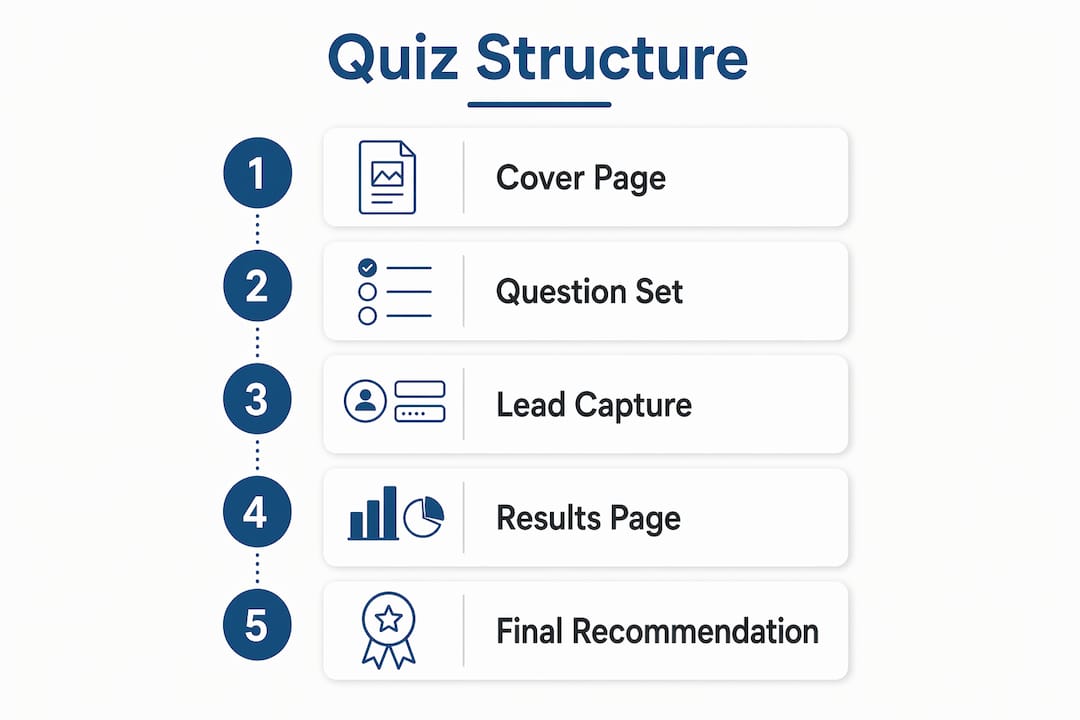
| Component | Purpose | Key requirement |
|---|---|---|
| Cover page | Attract and convert | Clear title, visual, and one-line hook |
| Questions | Collect scoring data | Each answer weighted to a category |
| Lead form (optional) | Capture contact info | Placed before results for best conversion |
| Results pages | Deliver personalized output | Unique copy per category, CTA included |
An optional lead capture form placed between the final question and the results page is a standard tactic in marketing-focused quizzes. Users who have invested time answering questions are far more likely to submit an email address than cold visitors.
The results pages
Results pages are where the quiz pays off. Distinct copy and recommendations per result category improve both conversion and user trust. Each result needs its own title, a two-to-four sentence description, and a call to action that fits the category. Generic text shared across all results destroys the sense of personalization that makes the format compelling.
Pro Tip: Write your results pages before you write your questions. Once you know exactly what each category represents, writing questions that cleanly separate users into those categories becomes much easier.
How do scoring models and question design impact quiz effectiveness?
Scoring is the engine of the character quiz format. The simplest model assigns one point to one category per answer. A user who picks the "bold and direct" option on five questions accumulates five points in the "Leader" category and gets assigned that result. This model is easy to build and easy to understand.
Fractional weights add nuance. An answer might give 0.7 points to "Leader" and 0.3 points to "Strategist," reflecting that the choice partially fits both profiles. This approach produces more accurate segmentation, especially when your categories share overlapping traits. The tradeoff is added complexity during the build phase.
Question design determines whether your scoring model actually works. Every question must pass what quiz designers call the segmentation test: if multiple answer choices point to the same category, the question fails to differentiate users and is essentially decorative. A question like "What is your favorite color?" rarely segments meaningfully unless the color choices are carefully mapped to distinct personality traits.
The following principles separate effective questions from filler:
- Scenario-based questions outperform preference questions. "You have one hour before a big presentation. What do you do?" reveals behavior. "Do you prefer mornings or evenings?" rarely does.
- Answer options should feel equally valid. If one answer is obviously "better," users will pick it regardless of their actual character, skewing results toward one category.
- Define your result categories first, then write questions. Treating result categories as primary design targets and writing questions afterward is the single most reliable method for building a quiz that segments well.
- Question count matters. For most character and personality quizzes, 5 to 8 questions is the optimal range for completion rates. Psychological assessments like Freudly's can justify more, but entertainment quizzes lose users fast beyond ten questions.
Pro Tip: After building your quiz, take it yourself and try to "game" each result category. If you can easily force any result by picking obvious answers, your questions need more ambiguity and your weights need rebalancing.
What design and UX patterns improve engagement and completion rates?
Quiz completion rates drop sharply when the interface feels like a form rather than a conversation. The design choices you make around layout, pacing, and visual presentation directly affect how many users reach the results page.
The most effective interactive character quiz design follows a clear sequence of UX principles:
- One question per screen. Showing all questions at once creates cognitive overload. One question per screen with a progress indicator turns the quiz into a conversation-like flow that keeps users moving forward.
- Visual answer options. Image-based answers process faster than text-only options. A quiz asking "Which environment energizes you?" lands better with photos of a mountain trail, a city skyline, a library, and a beach than with four text labels.
- Mobile-first layout. The majority of quiz traffic arrives on mobile devices. Buttons need to be large enough to tap without zooming, and images need to load quickly. A layout that works on desktop but breaks on a 375px screen loses a significant portion of your audience before they finish.
- Branching logic for longer quizzes. Typeform uses branching logic to show different questions based on earlier answers. This keeps the quiz relevant to each user and avoids asking questions that do not apply to their path. Branching should only be applied along questions that genuinely inform category differentiation. Adding branches for cosmetic variety without scoring logic behind them creates confusion in your results.
- Consistent tone throughout. A quiz that opens with playful copy and then shifts to formal language mid-way feels disjointed. Tone consistency signals quality and keeps users trusting the experience.
How should results pages be crafted for authentic personalization?
Results pages are the highest-leverage element of the entire quiz. A user who completes your quiz and receives a result that feels generic will not share it, will not trust the brand behind it, and will not return. A result that feels genuinely specific to them does all three.
Personalization is authentic only when result pages have unique language and actionable next steps per category. That means writing completely separate copy for each result. No shared paragraphs, no "regardless of your result" language, and no generic affirmations that could apply to anyone.
Strong results pages share these characteristics:
- A specific, memorable title. "The Quiet Architect" lands harder than "Result Type B" or even "The Introvert."
- Positive framing. Character quizzes are entertainment and self-discovery tools. Even a result that represents a challenging personality type should be framed as a strength or a growth opportunity.
- A concrete recommendation. Tell the user what to do next based on their result. This could be a book recommendation, a product suggestion, a related quiz, or a challenge to try.
- A shareable hook. The most viral quiz results include a line that users want to post. Something like "You see the solution before anyone else notices the problem" is more shareable than "You are analytical."
"The best results pages make users feel seen, not sorted."
Freudly's approach of showing ranked character matches with explanations is a strong example of this principle at scale. Rather than assigning one label, it shows users their top matches and explains why each one fits. That transparency builds trust and dramatically increases the time users spend on the results page.
Key takeaways
A well-built character quiz assigns weighted answer choices to predefined categories, delivers distinct personalized results per category, and uses one-question-per-screen UX to maximize completion rates.
| Point | Details |
|---|---|
| Define categories first | Write result categories before questions to ensure every question segments users effectively. |
| Use weighted scoring | Assign point values per answer choice per category; fractional weights improve accuracy for overlapping traits. |
| Optimize question count | Keep character quizzes to 5 to 8 questions for best completion rates on entertainment formats. |
| Write unique results copy | Each result category needs its own title, description, and call to action to feel genuinely personal. |
| Design for mobile UX | One question per screen, visual answer options, and progress indicators reduce drop-off on mobile devices. |
Why I think most character quizzes fail before the first question is written
Most creators start by writing questions. That is the wrong order, and it explains why so many quizzes produce results that feel arbitrary. When you write questions without locked result categories, you are essentially building a house without a floor plan. The questions might be interesting individually, but they do not add up to a coherent output.
The second mistake I see constantly is treating all result categories as equally likely outcomes. In practice, your scoring model will favor certain categories unless you deliberately balance the weight distribution across all questions. Test every category path before publishing. If one result is nearly impossible to reach, users who belong in that category will get misassigned, and the quiz loses credibility.
The third issue is tone mismatch. A character quiz on a lifestyle platform needs to feel warm and playful. The same format on a professional development platform needs to feel reflective and credible. The mechanics are identical. The language is completely different. Choosing the right tool matters here too. Typeform excels at polished, conversational UX. Opinion Stage is strong for embedding quizzes in content. Freudly demonstrates what a deep character library can produce at scale. Match the tool to the experience you want to create, not just the features list.
My honest advice: spend 40% of your build time on the results pages. That is where users decide whether the quiz was worth their time, and it is where they decide whether to share it.
— Pavan
Explore character quizzes and more on Worldlecity
If you want to see character and personality quiz formats in action, Worldlecity is worth exploring. The platform offers a growing catalog of fun quizzes spanning city guessing, lifestyle, characters, and personality formats, with new quizzes added regularly. Whether you are looking for inspiration on how to structure your own quiz or just want to experience well-designed interactive formats firsthand, Worldlecity gives you both. Participating in a well-built quiz is one of the fastest ways to understand what makes the format work, and what makes it fall flat.
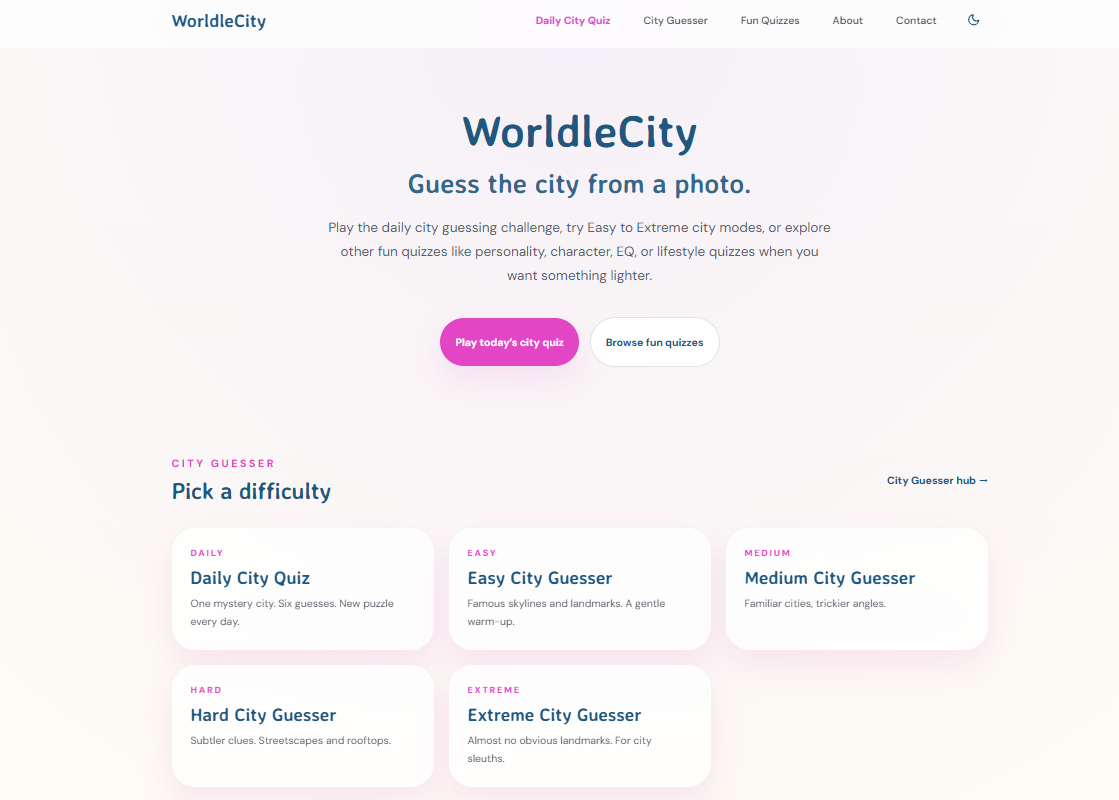
The variety on Worldlecity spans casual entertainment to more reflective personality formats, making it a practical reference point for anyone thinking seriously about quiz design and audience engagement.
FAQ
What is a character quiz format?
A character quiz format is a personality-style quiz that uses weighted answer choices to match users to predefined character archetypes or profiles. The category with the highest accumulated points at the end of the quiz becomes the assigned result.
How many questions should a character quiz have?
For most character and personality quizzes, 5 to 8 questions is the optimal range for completion rates. Longer formats like Freudly's 83-question quiz work for deep psychological matching but are exceptions rather than the standard.
What makes a character quiz result feel personalized?
Results feel personalized when each category has completely unique copy, a specific title, and a concrete recommendation. Generic text shared across all result categories makes personalization feel fake and reduces user trust.
How does branching logic work in character quizzes?
Branching logic shows different questions based on a user's earlier answers. Typeform implements this with a one-question-at-a-time interface, keeping the quiz relevant to each user's path. Branching should only be applied to questions that directly inform category scoring.
What is the segmentation test for quiz questions?
The segmentation test checks whether a question's answer choices point to different result categories. If multiple answers all point to the same category, the question does not differentiate users and should be rewritten or removed.