
Quiz pattern recognition is the systematic skill of identifying question structure, sequence logic, and format conventions before attempting an answer. Students and trivia competitors who learn quiz patterns and tricks consistently outperform those who rely on raw knowledge alone, because they spend less time decoding what a question is asking and more time retrieving the right answer. The core methods covered here include active recall, spaced repetition with tools like Anki, strategic elimination for multiple-choice formats, and timed practice with themed rounds. Whether you compete in pub trivia, academic quizzes, or online platforms like Worldlecity, these techniques apply directly to your performance.
What are the common quiz patterns and question types you need to know?
Quiz questions fall into recognizable pattern families, and knowing those families is the foundation of every effective quiz strategy. The five most common families are number sequences, logical reasoning, coding-decoding, seating arrangements, and analogies. Each family has a distinct internal logic, and misidentifying which family a question belongs to is the single fastest way to waste time and lose points.
| Pattern type | How to identify it | Key tip |
|---|---|---|
| Number sequences | A series of numbers with a hidden rule | Check for arithmetic, geometric, or alternating differences first |
| Logical reasoning | Statements requiring deduction | Map relationships before committing to an answer |
| Coding-decoding | Letters or symbols substituted for words | Find the substitution rule in the example pair |
| Analogies | "A is to B as C is to ___" | Identify the relationship type: function, category, or degree |
| Themed rounds | Questions grouped by a hidden or announced topic | Spot the theme early and use it to predict later answers |
Multiple-choice questions add another layer of complexity through plausible distractors. A well-designed multiple-choice question, as noted in quiz design principles, includes options that are mutually exclusive and equally plausible, which means you cannot rely on wording patterns or "all of the above" shortcuts. The distractor is built to attract the partially informed reader, so recognizing this design intent helps you slow down and evaluate rather than react.
Themed rounds deserve special attention. Quiz rounds with secret or announced themes allow easier pattern recognition and increase your chances of answering related questions correctly once you identify the connecting thread. A round about 1990s films, for example, tells you that every answer lives within a specific decade and genre, which narrows your retrieval search dramatically.
Pro Tip: Before reading the answer choices on any question, classify the question type. Write a one-word label in the margin: "sequence," "analogy," "fact," or "theme." This single habit forces deliberate thinking and cuts impulsive wrong answers.
How can you strategically approach multiple-choice quizzes to maximize your score?
Multiple-choice strategy is not guesswork with extra steps. It is a disciplined process that, applied consistently, raises your score on every quiz format from standardized tests to trivia nights.
-
Read the stem first, cover the options. Before you see the answer choices, read the question and form your own answer in your head. Reading the stem first prevents early bias from plausible distractors, which are specifically designed to attract readers who scan options before understanding the question.
-
Read every answer choice before selecting. Even if option A looks perfect, read through D. Quiz writers often place the most tempting wrong answer first. The correct answer is frequently the one that is most precise, not the one that sounds most familiar.
-
Eliminate clearly wrong options. Cross out any answer that is factually impossible or outside the question's scope. Skillful elimination is more reliable than guessing based on wording patterns, because strong quiz questions are designed to make all distractors plausible.
-
Guess when there is no penalty. In a four-option question, random guessing yields a 25% success rate, which means a blank answer is always worse than an educated guess. After elimination, even a two-option guess gives you 50% odds.
-
Rephrase similar options using "because." When two answers look nearly identical, complete the sentence: "The answer is X because..." If you cannot finish that sentence with confidence, you have identified a knowledge gap, not a trick question.
Pro Tip: If two answer choices are opposites of each other, the correct answer is almost always one of those two. Quiz writers frequently include an opposite pair to test whether you know the direction of a relationship, not just the topic.
What are effective practice techniques to learn quiz patterns and tricks?
Effective quiz study techniques are grounded in one principle: your brain retains what it actively produces, not what it passively reads. Active recall and retrieval practice improve retention to about 80% after one week, compared to roughly 34% for passive rereading. That gap is the difference between finishing in the top three at trivia night and forgetting half of what you studied the night before.
The most practical retrieval methods include:
- Flashcards with Anki: Anki uses spaced repetition to surface harder cards more frequently at optimal intervals. Short daily sessions with Anki outperform marathon cramming, particularly for building the fast recall speed that timed quizzes demand.
- Blank page recall: Close your notes, write everything you remember about a topic on a blank page, then check. The act of producing information from scratch creates stronger memory traces than recognition-based review.
- The Feynman technique: Explain a concept out loud as if teaching a ten-year-old. Where your explanation breaks down is exactly where your knowledge has a gap.
- Practice questions under timed conditions: Simulate the actual quiz environment. Set a timer, work through a full round, and score yourself honestly. Timed practice builds the mental pacing instinct that prevents you from spending four minutes on one question.
Peer-based practice adds a dimension that solo drilling cannot replicate. The Quiz Quiz Trade activity from Edutopia involves brief timed exchanges where participants trade question cards with different partners, exposing each person to varied phrasing and retrieval cues. This variety prevents "overfitting," where you only recognize an answer when it is phrased exactly as you studied it.
| Practice tool | Best use case | Time investment |
|---|---|---|
| Anki | Long-term retention of facts and sequences | 10-15 minutes daily |
| Blank page recall | Checking depth of understanding | 20 minutes per topic |
| Timed practice rounds | Building speed and pacing instinct | 30 minutes per session |
| Quiz Quiz Trade | Varied retrieval with peers | 15-20 minutes in groups |
| Feynman technique | Identifying knowledge gaps | 10 minutes per concept |
Structure your practice sessions around themed rounds of approximately ten questions each. Themed rounds of around 10 questions aid predictability, improve pacing, and increase engagement, which means you are more likely to complete the session rather than abandon it halfway through.
Pro Tip: Use a "blind review" loop after every practice session. Attempt recall first, check your answer, and if you were wrong, immediately try to recall the correct answer from memory before reading the explanation. This double-retrieval step strengthens the exact memory trace you need.
How do pattern classification and time management improve quiz performance under pressure?
Time pressure is where quiz preparation either pays off or falls apart. The difference between a prepared competitor and an unprepared one is not knowledge volume. It is the speed of classification.
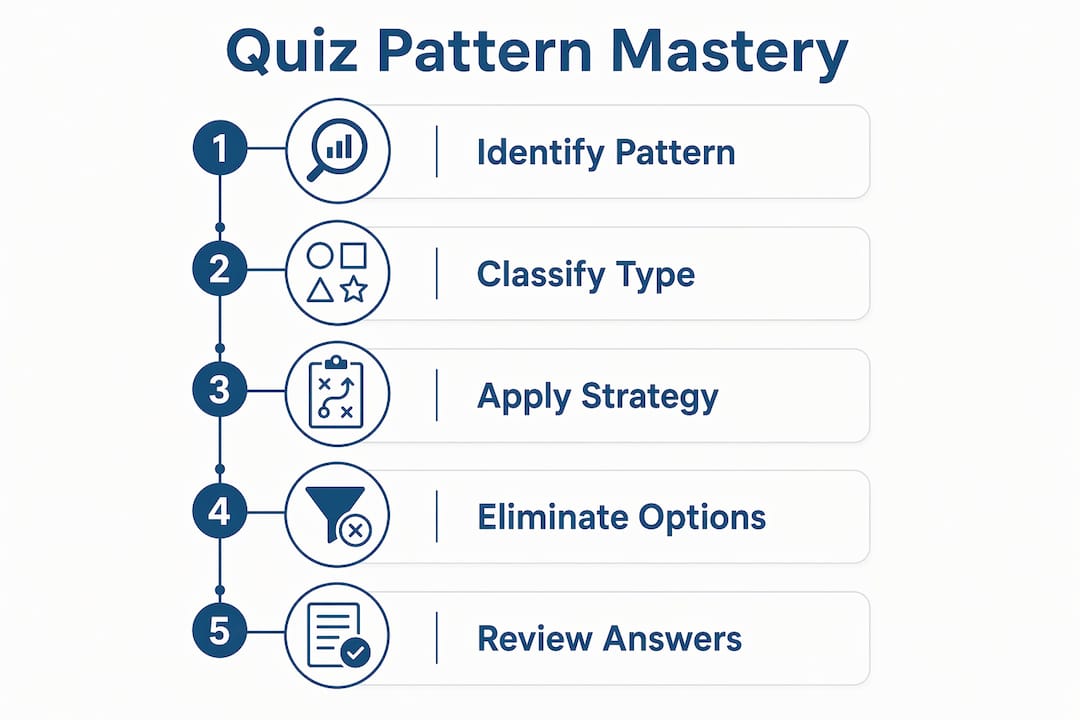
Classifying the logical pattern family first saves 30 to 60 seconds per question under time pressure. That is not a small margin. In a 20-question quiz with a 15-minute limit, saving 30 seconds per question gives you ten extra minutes, which is enough to revisit every question you flagged as uncertain.
The classification mental framework works like this:
- Arithmetic sequences: Each term increases or decreases by a fixed number. Check the difference between consecutive terms first.
- Geometric sequences: Each term is multiplied or divided by a fixed ratio. If arithmetic differences are inconsistent, check ratios.
- Alternating sequences: Two interleaved patterns running simultaneously. If neither arithmetic nor geometric fits, split the sequence into odd-position and even-position terms.
- Mixed or complex sequences: Combinations of the above. Classify as mixed only after ruling out the simpler types.
Misclassification often doubles solving time and causes higher error rates, because you apply the wrong solution method and then have to backtrack. Brute-force guessing without classification is the most expensive habit a quiz taker can have.
Practical time management under pressure follows three rules. First, set a personal time limit per question before the quiz starts, typically 45 to 90 seconds depending on format. Second, mark and skip any question that exceeds your limit on the first pass. Third, return to skipped questions only after completing all others. This sequence guarantees that easy points are never sacrificed to hard questions.
Pro Tip: Treat each quiz round as a data distribution problem. Quickly scan the first two or three questions in a round to identify the dominant question style, then allocate your mental energy accordingly. If a round is heavy on geography, shift into spatial memory mode before question one.
Key takeaways
Mastering quiz performance requires combining pattern classification, strategic elimination, and active retrieval practice into a single repeatable system.
| Point | Details |
|---|---|
| Classify before solving | Identify the pattern family first to save 30-60 seconds per question and reduce errors. |
| Use active recall daily | Retrieval practice delivers 80% retention after a week versus 34% for rereading. |
| Apply elimination in multiple choice | Discard impossible options first; guess from remaining choices when there is no penalty. |
| Practice with themed rounds | Groups of 10 themed questions build pacing instinct and pattern recognition simultaneously. |
| Vary your retrieval methods | Combine Anki, blank page recall, and peer activities like Quiz Quiz Trade for durable memory. |
What I've learned from years of watching quiz takers succeed and fail
Most quiz takers I observe make the same mistake: they study more content instead of studying smarter. They read another chapter, watch another documentary, and then freeze during the actual quiz because their brain has stored information in a passive, recognition-only format. Recognition is not the same as recall, and quizzes test recall.
The second most common pitfall is ignoring format. A student who has never practiced multiple-choice elimination will consistently pick the most familiar-sounding answer rather than the most accurate one. Familiarity and accuracy are not the same thing, and quiz writers know this. They build distractors specifically to exploit that confusion.
What actually works, in my experience, is the combination of pattern classification and active retrieval. These two skills are multiplicative, not additive. Pattern classification tells you what to retrieve. Active retrieval practice makes sure the information is actually there when you need it. Neither works as well without the other.
The social dimension of quiz practice is also underrated. Practicing with peers through activities like Quiz Quiz Trade exposes you to question phrasing you would never generate yourself, which is exactly the kind of variation that shows up in real competitions. Solo practice builds depth. Peer practice builds adaptability. You need both.
Finally, enjoy the process. Quizzes are genuinely fun when you feel prepared. Confidence built through preparation is qualitatively different from the anxiety of hoping you happen to know the answer. Preparation converts hope into expectation, and that shift changes everything about how you perform under pressure.
— Pavan
Practice your quiz skills daily on Worldlecity
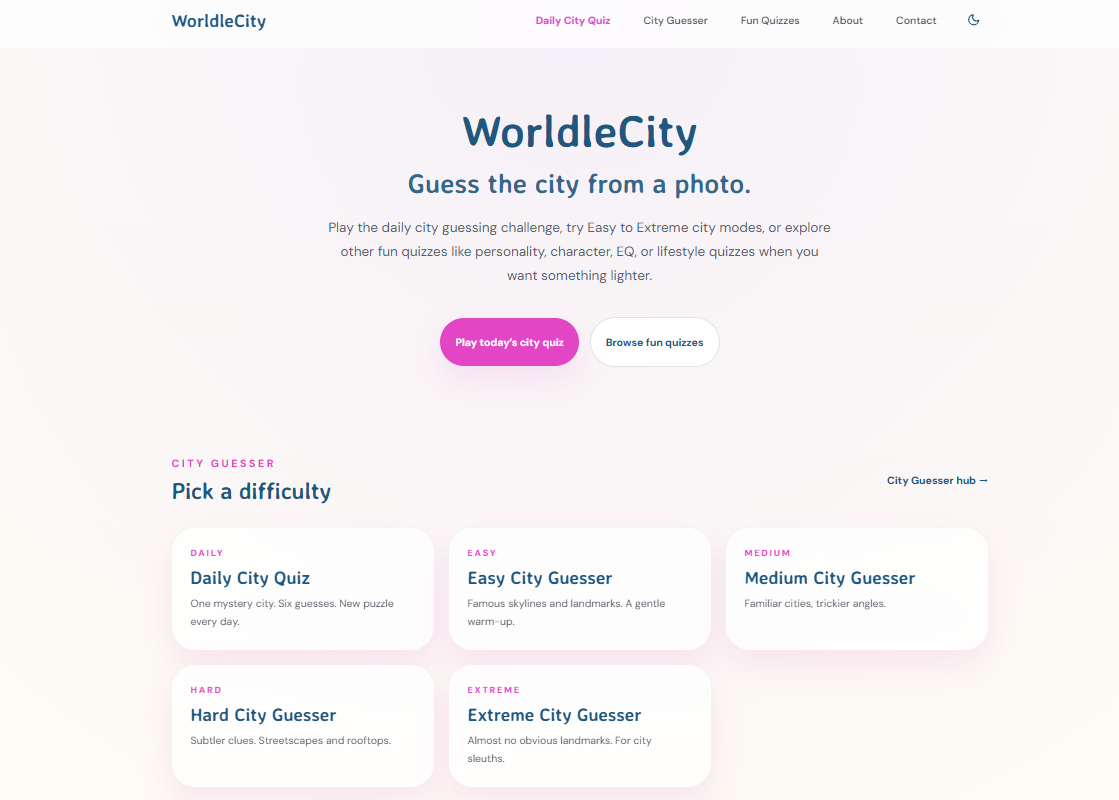
Worldlecity is a daily city-guessing quiz platform that also features fun rounds covering lifestyle, characters, and personality topics. Every quiz on Worldlecity is structured to give you real practice with the pattern recognition and themed-round strategies covered in this guide. The city-guessing format specifically trains spatial pattern recognition and process-of-elimination thinking, two skills that transfer directly to trivia competitions. If you want to apply what you have learned here in a low-stakes, engaging environment, Worldlecity gives you a fresh quiz every day to sharpen your instincts and build the pacing habits that separate good quiz takers from great ones.
FAQ
What does it mean to learn quiz patterns and tricks?
Learning quiz patterns and tricks means training yourself to recognize question structure, sequence logic, and format conventions before attempting an answer. This skill reduces decoding time and increases accuracy across multiple-choice, sequence, and themed-round formats.
How much does active recall improve quiz retention?
Active recall improves retention to approximately 80% after one week, compared to about 34% for passive rereading. Flashcard tools like Anki and blank page recall exercises are the most practical methods for building this habit.
When should you guess on a multiple-choice question?
Guess whenever there is no penalty for wrong answers. A random guess in a four-option question gives you a 25% success rate, which is always better than leaving a blank. After eliminating one or two options, your odds improve to 33% or 50%.
How does classifying a pattern type save time in quizzes?
Identifying the pattern family before solving saves 30 to 60 seconds per question. Misclassification forces you to backtrack and apply a second solution method, which can double your solving time and increase error rates under pressure.
What is the best way to practice for trivia competitions?
Combine timed practice rounds of around 10 themed questions with peer-based retrieval activities like Quiz Quiz Trade. This pairing builds both speed and adaptability, the two performance factors that matter most in competitive trivia settings.