
A personality quiz is a structured set of questions designed to reveal your psychological traits, preferences, or behavioral tendencies, helping you understand how you think, feel, and interact with the world. These tools range from rigorous academic instruments like the Big Five (OCEAN) model to casual five-minute entertainment formats on platforms like 16Personalities. Whether you're chasing genuine self-awareness or just curious what kind of historical figure you'd be, personality quizzes serve a real purpose. They've become one of the most popular forms of self-directed reflection online, and understanding how they work makes your results far more useful.
What is a personality quiz and how does it work?
A personality quiz is a self-report assessment tool that uses targeted questions to categorize or profile your psychological characteristics. The formal term used by psychologists is personality assessment, and it covers everything from peer-reviewed academic instruments to lighthearted pop culture formats. The key distinction is that a quiz asks you to describe yourself, then maps your answers to a predefined framework of traits or types.
The mechanism is straightforward. You answer a series of questions about your preferences, reactions, or habits. The quiz scores your responses and places you within a personality profile, type, or spectrum. Tools like the Myers-Briggs Type Indicator (MBTI) assign you one of 16 personality types based on four dichotomies. The Big Five model scores you across five continuous dimensions: openness, conscientiousness, extraversion, agreeableness, and neuroticism.

What separates a personality quiz from a clinical psychological evaluation is context and intent. Clinical assessments, like the Rorschach inkblot test or the Minnesota Multiphasic Personality Inventory (MMPI), are administered by licensed professionals for diagnostic purposes. Personality quizzes, even rigorous ones, are self-administered tools for insight and reflection. Knowing this distinction helps you calibrate how much weight to give your results.
What are the main types of personality quizzes?
Personality assessments fall into four main categories: trait-based, type-based, casual entertainment quizzes, and clinical projective tests. Each serves a different purpose and operates at a different level of scientific rigor.
| Quiz type | Example | Duration | Best for |
|---|---|---|---|
| Trait-based | Big Five (OCEAN) | 15 to 45 minutes | Research-backed self-understanding |
| Type-based | MBTI, 16Personalities | 10 to 30 minutes | Preference mapping and team dynamics |
| Casual/entertainment | Animal archetypes, pop culture | 2 to 10 minutes | Fun, ice-breaking, social sharing |
| Clinical projective | Rorschach, MMPI | 45 to 90+ minutes | Professional psychological evaluation |
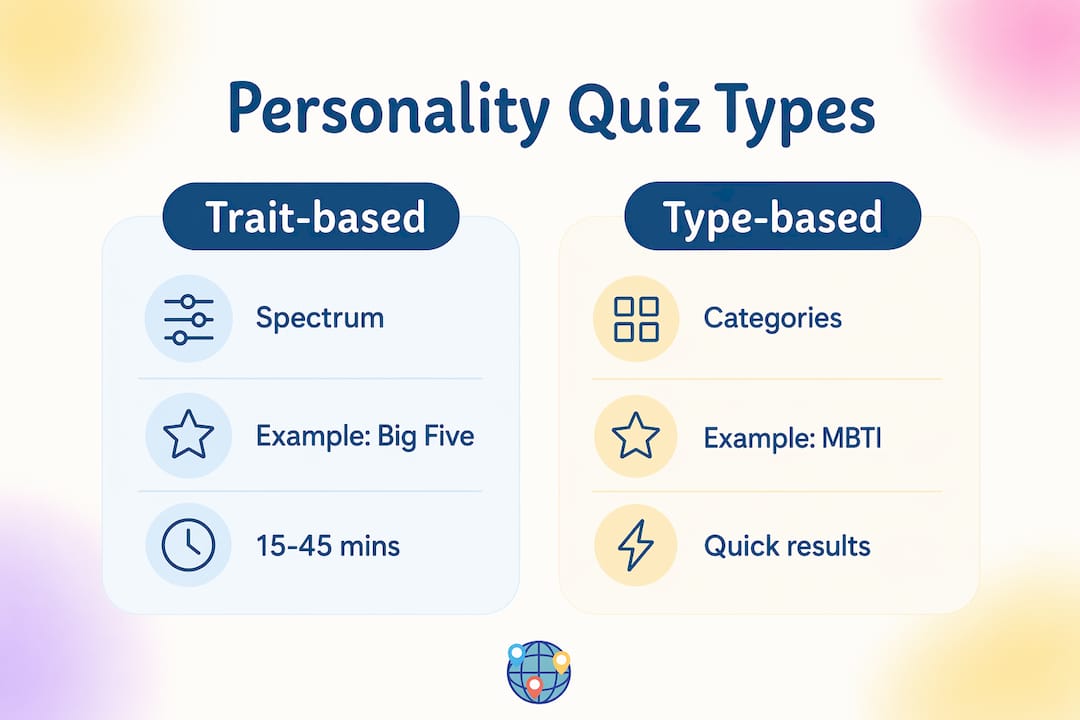
Trait-based quizzes measure personality along continuous spectrums rather than placing you in a fixed box. The Big Five is the gold standard here. It scores you on each of the five OCEAN dimensions from low to high, giving you a nuanced profile rather than a single label.
Type-based quizzes assign you to a discrete category. The MBTI places you in one of 16 types, such as INFJ or ESTP, based on your preferences across four pairs of opposites. 16Personalities has been taken by over 190 million people and takes roughly 10 minutes with about 60 questions. That scale reflects genuine public appetite for self-knowledge in an accessible format.
Casual entertainment quizzes prioritize engagement over accuracy. Think "Which Hogwarts house are you?" or "What does your morning routine say about your personality?" These are built for sharing and fun, not clinical insight. They still carry value as conversation starters and low-stakes self-reflection prompts.
Clinical projective tests belong in a therapist's office, not on your lunch break. They require professional interpretation and are designed to surface unconscious patterns, not just surface preferences.
Pro Tip: Before you start any quiz, check the character quiz format to understand how questions are structured. Knowing the format helps you answer more naturally and get results that actually reflect you.
How to take a personality quiz effectively
Getting real value from a personality quiz depends almost entirely on how you approach it. Most people unknowingly sabotage their results before they answer a single question.
-
Answer as your private self, not your public persona. Many test-takers answer based on social or professional personas rather than their true selves. Accuracy improves when you respond as you are when no one is watching. Ask yourself: "How do I actually behave, not how do I wish I behaved?"
-
Trust your first instinct. Over-analyzing individual questions reduces result accuracy. Personality assessments work by aggregating patterns across many responses, not by dissecting any single answer. Your gut reaction is statistically more reliable than a carefully reasoned response.
-
Define your goal before you start. Defining your goal before taking quizzes and comparing results across multiple reputable tests increases the usefulness of your results. Are you exploring career fit, relationship dynamics, or just having fun? Your goal determines which quiz type makes sense.
-
Take more than one quiz. No single assessment captures the full picture. If you consistently score high on extraversion across the Big Five, MBTI, and two casual quizzes, that pattern is meaningful. One outlier result tells you less than three consistent ones.
-
Treat results as a starting point, not a verdict. Your results show tendencies and archetypes, not fixed truths. Use them to open questions about yourself, not close them.
Pro Tip: If your results surprise you, that's useful data. Sit with the discomfort before dismissing the outcome. Sometimes the most revealing results are the ones that feel slightly off.
What are the benefits and limitations of personality quizzes?
Personality quizzes offer genuine value when used correctly, and real risks when treated as gospel.
Benefits include:
- Self-awareness. Seeing your traits mapped out can surface patterns you hadn't consciously recognized. Many people report that reading their Big Five results clarified why certain work environments energize or drain them.
- Communication improvement. Understanding your own tendencies, and those of people around you, makes it easier to navigate conflict and collaboration.
- Social engagement. Casual quizzes work well as party entertainment and ice-breakers at social gatherings, creating shared conversation without requiring personal disclosure.
- Low-stakes reflection. Even entertainment quizzes prompt you to think about your preferences, which has mild but real reflective value.
The limitations are equally important to understand. The Barnum Effect causes people to perceive vague personality descriptions as highly accurate. Named after showman P.T. Barnum, this psychological phenomenon explains why you read a horoscope-style description and think "that's exactly me." Vague statements feel personal because they're written to apply broadly. This creates an illusion of accuracy in informal quizzes that can lead to over-identification with a label.
"Experts warn against pigeonholing yourself based on quiz results, as it can hinder personal growth. Personality evolves over time, and test results should be used for exploration rather than strict labeling."
Scientific reliability also varies sharply across quiz types. The Big Five is considered by experts the most accurate personality tool, built on large-scale data analysis rather than abstract theory. The MBTI, while enormously popular, shows poor test-retest reliability. About 37% of people receive a different type on retaking the MBTI. That's not a reason to dismiss it entirely, but it is a reason not to tattoo your four-letter type on your forearm.
How do popular personality tests like the MBTI and Big Five compare?
The MBTI and Big Five are the two most referenced personality assessment tools in both popular culture and academic research. They measure personality differently, and understanding that difference helps you choose the right one for your needs.
| Feature | MBTI / 16Personalities | Big Five (OCEAN) |
|---|---|---|
| Output | 16 discrete personality types | Five continuous trait scores |
| Scientific backing | Moderate, widely debated | Strong, research consensus |
| Test-retest reliability | Lower (37% retype rate) | Higher, more consistent |
| Accessibility | High, free versions widely available | High, multiple free versions |
| Best use case | Self-reflection, team communication | Research, career counseling |
| Duration | 10 to 30 minutes | 15 to 45 minutes |
The MBTI organizes personality into four dichotomies: Introversion/Extraversion, Sensing/Intuition, Thinking/Feeling, and Judging/Perceiving. Your combination produces one of 16 types, like INTJ or ENFP. The appeal is clarity. A four-letter label is easy to remember, share, and discuss. 16Personalities made this format globally accessible with a free, polished version that has reached over 190 million users.
The Big Five takes a fundamentally different approach. Rather than placing you in a category, it scores you on five independent dimensions. You might score high on openness and low on conscientiousness, creating a profile that's uniquely yours rather than one of 16 shared buckets. Big Five is widely accepted by researchers as the most reliable tool for measuring personality variation globally. It's the framework most used in academic psychology and large-scale workforce research.
The honest answer is that both have a place. Use the MBTI or 16Personalities when you want a memorable, shareable framework for self-reflection or team conversations. Use the Big Five when you want a more scientifically grounded picture of where you sit on each personality dimension.
Key takeaways
Personality quizzes are most valuable when you treat them as mirrors for reflection rather than definitive labels, choosing the right type for your goal and answering as your authentic self.
| Point | Details |
|---|---|
| Four quiz categories exist | Trait-based, type-based, casual, and clinical tests each serve a different purpose and rigor level. |
| Big Five is most reliable | Researchers consistently rate the Big Five (OCEAN) as the most scientifically valid personality tool available. |
| Answer authentically | Responding as your private self, not your social persona, produces significantly more accurate results. |
| Results show tendencies, not truths | Personality is fluid and evolves over time, so treat quiz outcomes as starting points for reflection. |
| Compare multiple tests | Consistent patterns across several quizzes carry more meaning than any single result. |
Why I think most people misuse personality quizzes
I've watched the personality quiz space evolve from a niche psychology interest into a mainstream cultural fixture, and the most common mistake I see is treating a four-letter type or a single score as a permanent identity. People introduce themselves as "an INFJ" the way they'd state their blood type. That's not self-awareness. That's self-limitation dressed up as insight.
The quizzes themselves aren't the problem. The Big Five, used honestly, surfaces real patterns. Even casual formats have value as reflection prompts. The problem is the human tendency to grab a label and stop questioning. Personality is genuinely fluid. The person you were at 22 scores differently at 35, and that's not a bug in the system. It's evidence that you've grown.
What I've found actually works is using quiz results as a conversation starter with yourself. When a result surprises you, that's the interesting moment. Sit with it. Ask why it feels wrong, or why it feels uncomfortably right. The quiz isn't the destination. It's the question that gets you thinking.
I also recommend learning quiz patterns before you invest time in a long assessment. Understanding how questions are structured helps you answer more naturally, which produces results that are actually worth reflecting on.
— Pran Gran
Explore personality quizzes on Worldlecity
Worldlecity offers a range of personality and lifestyle quizzes you can take right now, no account required. Whether you want a quick five-minute personality snapshot or a more thoughtful self-discovery experience, the platform makes it easy to jump in and share your results. Worldlecity is built for people who want genuine engagement without friction. Beyond personality formats, you'll find the daily city guessing game and geography challenges that sharpen your knowledge while keeping things fun. If you've been curious about what a personality quiz can reveal about you, this is the place to find out.
FAQ
What does a personality quiz actually measure?
A personality quiz measures your self-reported preferences, behavioral tendencies, and psychological traits across a defined framework. Depending on the type, it may output a discrete personality type like an MBTI label or a scored profile across dimensions like the Big Five's OCEAN model.
How accurate are free online personality quizzes?
Accuracy varies significantly by quiz type. The Big Five is considered the most scientifically reliable, while MBTI shows a 37% retype rate on retesting. Casual entertainment quizzes prioritize engagement over accuracy and should be treated as reflection prompts rather than definitive assessments.
Why do my personality quiz results change over time?
Personality is fluid and evolves with life experience, so results shifting between retakes is normal and expected. Experts recommend using quiz results for exploration rather than treating them as fixed labels, since personal growth naturally changes how you respond to questions.
What is the Barnum Effect in personality quizzes?
The Barnum Effect is a psychological phenomenon where people perceive vague, broadly written descriptions as highly personal and accurate. It explains why casual quiz results often feel surprisingly on-point, even when the descriptions apply to almost everyone.
Which personality quiz should I take first?
Start with the Big Five if you want a research-backed profile, or try 16Personalities for a quick, accessible type-based result. Define your goal first: self-reflection, career insight, or entertainment each point toward a different quiz format.